Il s’agit pour moi d’être plus qu’un homme.
Most of my reading list is constituted of chance encounters. What prompted me to read Yourcenar’s magnum opus is no different. I first discovered the Memoirs of Hadrian when browsing the blog of a person I admire much, especially due to their intellectual range. The second omen was Joanna Biggs’ LRB piece on the Immortelle, a welcome sign to start reading her works at the earliest opportunity. I stepped into the breach during the vacant summer of 2025. Then, just last month, I finished The Abyss. Here are my verbose thoughts.
Marguerite de Crayencour
was born in a solvent Belgian aristocratic family. Her mother passed early, ten days after her birth, making the father her sole guardian and tutor. Importantly, he would be the one to introduce her to the literary thing early in her life – they read Tolstoy, Marcus Aurelius and Lagerlöf aloud together when she was just thirteen. Her pen name and later surname, Yourcenar, was found in a concerted effort with him. She followed him during his trips and continued to live a bohemian, transient lifestyle after his death until the breakout of World War II. Later on, she famously moved to Mount Desert Island with her partner Grace Frick, from 1950 up to her death in 1987. Living as a recluse from the French literary scene, Yourcenar took up a professorship at Sarah Lawrence college as her inherited wealth eventually ran out – a job with a frankly indecent commute, which she hated.
The first woman to be elected to a seat at the Académie Française, she was nevertheless entirely indifferent to the cause of women in literature. Some even declare that her appointment was essentially political, it taking place under Valéry Giscard d’Estaing’s auspices would put him on the progressives’ good side. Anyhow, Yourcenar seemed to care very little about her induction ceremony, preferring to join friends in the Marais for the evening instead. To me, these fragments of history started to look like overwhelming evidence of a callous character, especially when watching the sparse interviews she has given; a divisive personality, she seemed cold, distant and always laconic in her answers, much to the dismay of her interviewers.
However, discovering her personality after reading the novel only made the state of awe I was in more complicated to discard. The contrast could not be starker, as the Memoirs became my favourite novel – a treasure trove of humaneness like I had not encountered before or since, even though it was written by this notoriously frigid character. The book is a melting pot of genres: historical novel, philosophical tale as well as bildungsroman. The latter is probably why it resonated with me so much: like Hesse’s Siddartha, the wisdom dispensed in the text acts like a catalyst for someone going through the early adult life.
From Hadrian’s retrospective on his going through the cursus honorum to his life as the Emperor, the breadth of themes he touches upon is astonishing. Using his voice, Yourcenar explores the relationship between a Man and his ageing body, the nature of true love by way of Hadrian’s relationship with Antinous and the skepticism necessary to all interactions with interested characters, especially in the ruthless, cut-throat context of Roman politics. To that I would add that the Memoirs act as an unexpectedly potent guide to policymaking, the Emperor regularly expounding on the right and reasonable way to lead his subjects towards days of peace and plenty.
Finally, in its merely historical aspect, the book is extraordinarily accomplished, thanks to Yourcenar’s scholarship and her long sojourns in the Yale library. Historians indeed recognise the novel as a thorough feat of accuracy. And this multifaceted work is propelled by Yourcenar’s prose - that of a master at the height of her powers. Here is a glimpse of that supremely beautiful voice speaking through a no less extraordinary character: “I knew that good like bad becomes a routine, that the temporary tends to endure, that that what is external permeates to the inside, and that the mask, given time, comes to be the face itself” (trans. Grace Frick). The author, in her crowning achievement, did justice to the central figure of what Machiavelli referred to as “the five good Emperors”.
The Abyss
as a main title is a damaging loss of meaning compared to that of the French version, l’Oeuvre au Noir, where the English heading is reserved for a markedly introspective chapter: L’abîme. Coming from the ancient Greek abyssos (bottomless pit), its polysemy gives the underlying passage several readings; it is either something that is impenetrable to reason, a going through (metaphorical) hell, or simply used the as a reference to Zeno’s delve into his own body, as he begins to understand its true nature. On the other hand, l’Oeuvre au Noir, in Yourcenar’s own words, “is the phase of separation and dissolution of substance which has been said to be the hardest part of the [alchemical] Magnum Opus. Whether this expression is applied to audacious experiments on matter or extends symbolically to the trials of Spirit liberating itself from routines and preconceived opinions is still up for debate. It has meant one thing or the other, sometimes both” (trans. your humble servant). To conclude this rambling about a minor bump in translation, I will add that it could be the author’s deliberate choice, as the novel was adapted into English by Grace Frick, Yourcenar’s partner and devotee, with the latter’s concert.
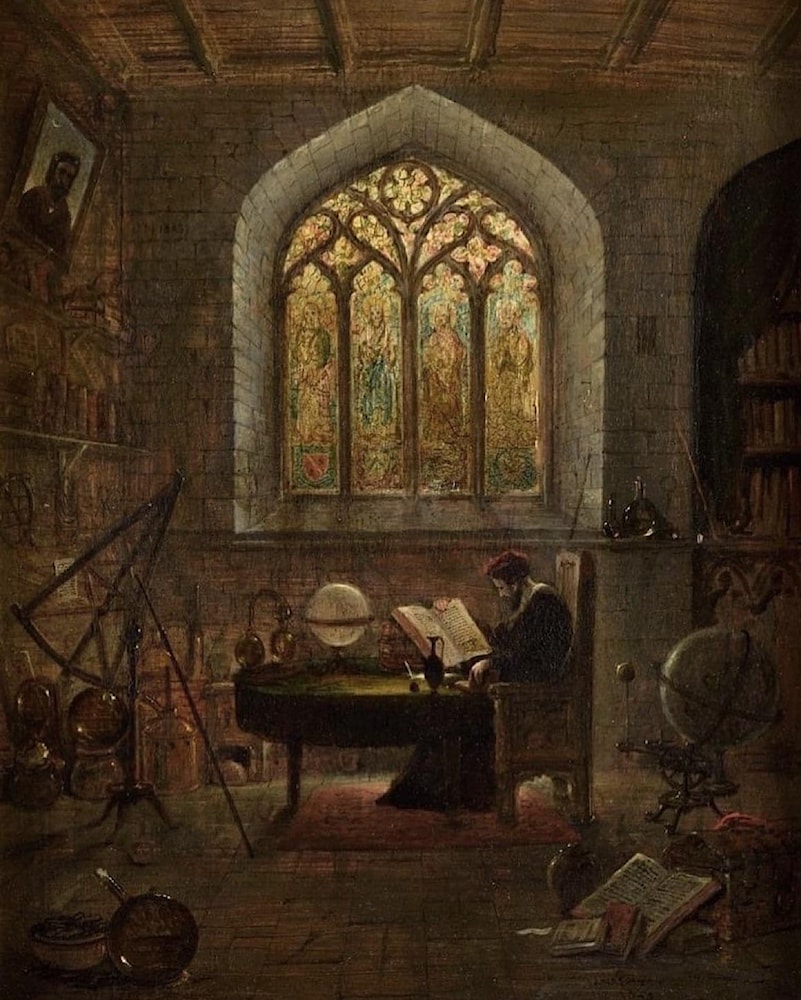
The narrative follows Zeno, illegitimate son of a supremely affluent merchant family in Bruges born in 1510, betwixt the Middle Ages and Renaissance. Destined for the high ranks of the clerical order, he dazzles by his intelligence at the Leuven seminar, under the auspices of powerful figures. Chief amongst them is Bartholomew Campanus, a pragmatic canon that will introduce his disciple to alchemy. In spite of these potentialities, Zeno renounces the cushy path of the clergyman and its dogmas for a nomadic life dedicated to the study of sciences, the practice of medicine and experimentation with alchemy. From then on until his later settling in Bruges, everything we know about him is unreliable; his voyages and encounters with exotic and kingly characters are only reported to the reader via hearsay. Zeno’s writings are the only clues indicative of his opinions and stays in the occidental world, with the latter being put to fire and sword as bloody religious wars are in full effect. Meanwhile, the alchemist becomes estranged from the guardian angels which kept censorship and torture at bay. After settling back in Bruges for a time, his writings and free-spirited demeanour catch up to him: the third leg of the story is set in the Inquisition’s prison. There, Zeno, disgusted by the dark ages’ brand of cruelty and fearful of torture, puts an end to his life.
From a historical perspective, the novel is on-par, if not superior the Memoirs’ command. It goes through transfixing descriptions of the period’s folly such as the 1534 Anabaptist uprising in Münster whilst also covering a host of truculent characters such as poisoners, grey eminences and lesser-known savants. Zeno’s fictitiousness makes it a vessel for Yourcenar’s erudition, and she shaped him as an amalgam of several legendary martyrs and other esoteric notables such as Paracelsius or Etienne Dolet, when Hadrian was constrained by the historical boundaries of his life.
Like its main character, the novel positively baffled me by its learnedness and range. It was no surprise to learn that Yourcenar had written a few drafts in her teenage years and finished the work in the winter of life: meditations on her own experiences permeates the story, beautifying it with her wisdom. If Hadrian’s teachings resided in humaneness, lone Zeno’s are about scepticism, the power of reason and open-mindedness – the latter manifesting most through the Flemish alchemist’s visits to the remote lands of sultans and Norse.
That epistemological doubt – the cause of Zeno’s attitude and ultimately of his demise – as well as the circumstances of his passing have brought some to qualify the savant’s life of “Socratic”. And whilst I can agree that he deconstructs his contemporaries’ beliefs and mores as Socrates would in one of the classic dialogues, I would have some trouble conceding that he passes away quite like Athens’ very own.
The divergence in the analogy is key to my understanding of the character and novel, thus I’ll go on some length about it. In the Crito, Socrates refuses to escape his prison and fate, as Athens’ rule of law is the environment that he was brought up in, and which has given him everything. Therefore, abiding by the judgement that was rendered against him, even if the law is wielded by the unreasonable, is what he must do. On the other hand, Zeno puts an anticipated end to his days by slitting his veins, wanting to escape torture and the stake. In that manner, he contravenes the acceptation of fate and the respect of judgement that are characteristic of Socrates’ end. I think that it is actually quite telling about the alchemist’s life, pragmatically spent avoiding the heat and insane censorship brought about by wars of religion by moving out of this or that jurisdiction, never partaking in the lowly “public sphere”.
Also, further contrasting with Socrates’ unwavering commitment to his philosophy, Zeno’s pragmatism seems to fail him at the worst time. Indeed, he is given the chance to escape from certain doom in the prison of the inquisition by his mentor, the staid Bartholomew Campanus, if he renounces his deviant beliefs in writing. Despite the alchemist’s mercurial sense of allegiance, he refuses to yield and stays on course for martyrdom, as if to prove a point. For all that knowldge and detachment, he remains proud and hard-headed. Wanting to make a show of force to his old tutor and the institution he represents, the son of Bruges resigned himself to a demise he could have well avoided. Perhaps Zeno became a gnostic during his travels and relished that liberation, as that quote early in the novel could lead us to think: “I’m twenty, said Zeno. At best, I have fifty years ahead of me before my trusted head turns into a skull. Keep your heroes and stories from Plutarch, Henry. I am striving to be more than a Man” (trans. me). I take this missed chance as a cautionary tale about the scepticism brought about by the life of the mind, the impression of wiser-than-thou procured by levels of abstractions that one can experience through study and scholarship. Anyhow, Marguerite Yourcenar’s magnum opi are literary tours-de-force that I would thoroughly recommend to anyone, and which should warrant a rereading of mine fairly soon.
J.G.